Overview
This page describes in detail the in-class activities that appear throughout the course schedule. References to these activities on specific Day pages link out to here, as to not repeat the descriptions multiple times and to clarify that some of these are reoccurring activities that we will revisit multiple times during the semester. Activities are listed here in alphabetical order.
Complicating pictures
- Students will separate into groups of two.
- The instructor will give a detailed image to one student in each pair to look at, in silence (3 minutes).
- The student looking at the image is to take in the elements of the image that are salient to them. After three minutes students who were looking at the images will be asked to flip them over and describe the image to their partner, who will draw a rough sketch on a separate piece of paper while their partner is describing (5-10 minutes).
- Now, each pair exchanges their image with the pair next to them and begins again, this time with the person who drew looking and the person who looked drawing (8-13 minutes).
- In groups of four now (the two pairs who swapped images), students hold a group discussion about their respective experiences of looking/noticing and drawing (5-10 minutes).
- What changed in the second round?
- What do you think changes about your noticing if you know you have to describe something afterwards?
- Is this sort of description that comes up in other places/times in your life?
- If so, where/when?
- Come together to discuss as a class if fitting.
Part of Day 15: Describing. Approximate duration: 35 minutes
Flip books
In this activity, you will create a flip book animation. You will need at least 30 empty sticky notes and a drawing implement. This is an exercise in repetition.
- Create a simple drawing on a sticky note. You will be repeating this drawing many times, so do not overcomplicate it. It does not need to be realistic, and can be of anything or nothing at all: a person (human or other-than-human), a landscape, an object or simply an abstract shape.
- Recreate your drawing on the next sticky note, introducing a small change: a slight movement or deformation. Do not trace your drawing, it does not need to be perfect. Try to spend no more than a minute on each drawing.
- Repeat the previous step until you have 30 sequential drawings, or until 30 minutes have passed. Stick the notes t0gether and flip through them.
- While you draw, feel free to talk and discuss with your classmates. Let your conversation guide the story that you are creating.
After you have finished your flip book, spend 10 minutes discussing the following questions with your class:
- What, if anything, changed about the act of drawing as you proceeded through the pages from front to back?
- How did the image you intended to draw change?
- What did you draw into the act of drawing through your thoughts and conversations as you drew?
Part of Day 9: Repetition. Approximate duration: 40 minutes
Mapping
Let’s orient to what it is that we orient to.
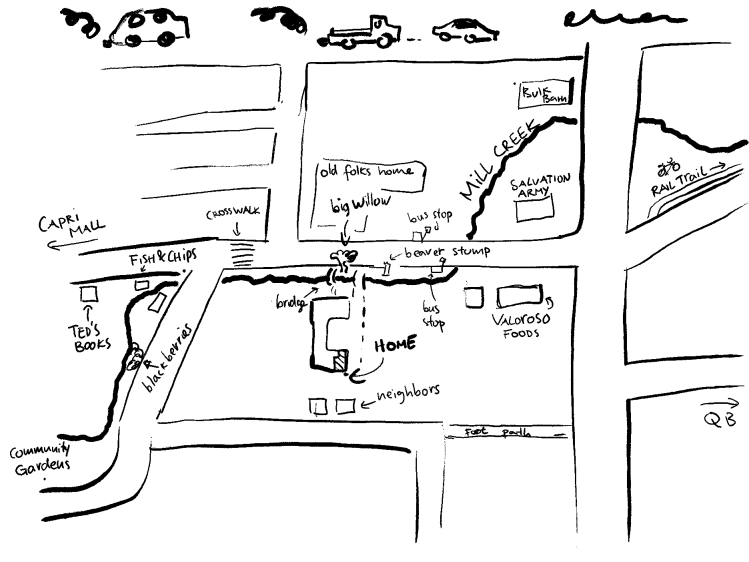
- Draw a map of your neighbourhood from memory, with your home at the centre. It does not need to be accurate or to scale. A large sheet of paper will be provided, but you do not need to fill it: start small so that you have room to expand.
- Draw and label the objects that serve as landmarks to you, that draw your attention, or that hold special meaning to you.
- Draw continuously for 20 minutes. You will find that more details will come to you as you draw.
- Then, spend 10 minutes sharing and discussing your map with your classmates. What kind of things did you include that others didn’t?
Part of Day 8: Walking. Approximate duration: 30 minutes
Rapid-fire multi-media captioning
Each participant will have submitted one uncaptioned recording for this activity, which the instructor will have combined into a slide show. Now, we will rapidly cycle through these recordings and caption them as fast as possible.
- You will have 30 seconds to caption each recording, before moving directly on to the next one.
- If the recording consists of video or audio, you will have 30 seconds after the recording finishes playing.
- The instructor will keep time.
Part of Day 14: Captioning. Approximate duration: 10-20 minutes
Story time
- The instructor will bring a story to class to read or tell aloud.
- If possible, invite a storyteller, ideally someone of the Land where you are teaching, who knows the stories of this/that place and is eager to share those stories with respectful audiences.
- You may choose to discuss the story afterwards, or perhaps share some minutes of silence after the story has finished such that those who have just received the story can be with it and allow it to percolate before trying to put words to the listening experience.
Part of Day 19: Story(ing). Approximate duration: 45 minutes
Terminology augmentation
- Get together in groups of 2 to 4 students.
- In your groups, look through the class Terminology page. Either choose a definition on the list to modify or augment from your collective experience wading through the practice to which they relate, or, add an entirely new definition to the list.
Part of Day 23: Extension in practice. Approximate duration: 30 minutes
Three good things
-
the colour of the sky this morning
-
humans in funky hats at a parade yesterday
-
a plant with a squiggly leaf that I walked by on my way home made me laugh
- a friend brought over tasty dinner last night
- this morning it was hard to get out of bed so I let myself sleep an extra 20 minutes and that turned out to be a really nice idea
- I saw on a farm stand sign that watermelon is now in season; I love watermelon
- the smoke cleared enough to be able to open the windows in the morning
- etc.
When three minutes have ended the floor will be open to anyone who wishes to share one or more of their good things with the class.
This is a gratitude practice and an exercise in recall and formulated as a primer to draw participants’ attention to that which calls and captures their attention in their everyday. Three good things is also a practice of drawing experiences from outside in to the classroom. Beginning each class this way calls each participant to spin filaments of connection as the first and most important learning activity.
Part of every class from Day 2 onward. Approximate duration: 5-7 minutes
Walking together
Walking outside together as a class is something we will do multiple times during the semester. In all incidents, we will take the time necessary for the class participants present, to transition from inside to outside or vice versa. We will not walk far or in harsh weather. Being outside together will allow us to anchor our individual Attentive Repetition practice to our in-class relationships with each other.
Attending to practice
For this walking together exercise, we will focus on walking, together. As a group, walk around campus while keeping your full attention on the mechanics of your body. How does your foot strike the ground, how does your weight shift from one leg to the other? What do you do with your arms as you walk? Where do you feel your eyes drawn? If you use a mobility device, focus on the forces and motions that your device conveys onto your body.
Part of Day 8: Walking. Approximate duration: 25 minutes
Drawing
We explore the world with our senses; the body’s way of researching the environment. Let us gather sensory information and represent it through drawing.
- Spend 5 minutes smelling things. 5 minutes drawing.
- Spend 5 minutes feeling textures. 5 minutes drawing
Inspiration may be found in Natasha Myers’s smellscapes and textures practices.
If possible, address the attribute of the surrounding environment in both the smell and touch rounds. For example, spend time with your nose up against the bark of a tree, so close but not quite touching. After taking time to draw, return to the same tree, placing your hand on bark you were recently smelling. See what happens in your drawing round.
Part of Day 7: Drawing. Approximate duration: 35 minutes
Giving thanks
We have learned much from the Land over the course of the semester. Together as a class we will go outside and give thanks to the Land for past and future teachings. On Syilx territory, at UBC Okanagan, it may be appropriate to invite an Elder or Syilx knowledge keeper to guide the class in a gratitude activity. This will depend on resources available for compensation as well as the relationships the instructor has in the community.
While it is a gift and privilege to have a Syilx Elder or knowledge keeper present as a guide, it is always possible to give thanks to Land in your own way. For example, class participants could bring in a leaf of a houseplant, which they have cared for with their time and attention, to give to the Land in thanks.
Part of Day 22. Approximate duration: 30 to 60 minutes
Greet a tree
For this exercise, participants will need a device with a timer*. Walk together into a forested area. At UBC Okanagan, there is such a forest northwest of campus. Once there, disperse and walk alone until you find a tree that solicits your attention. Then, set your timer for 20 minutes.
To greet the tree, place your hand on it and close your eyes. Then wait. Wait past human impatience. Trees live at a different pace. Feel the tree and wait until your timer goes off.
While walking back, reflect on what you felt. Did the feeling of the bark change as you waited? Were you uncomfortable, bored or distracted? How did you experience the passage of time?
*If you do not have a timer, you can stay within the vicinity of someone who does.
Part of Day 11: Making and holding time and space and Day 18: Encounter(ing).
Approximate duration: 40 minutes
Listening
Listening is a whole body experience. For this we will close our eyes and listen as a group.
- Start by trying to identify as many sounds as you can. Try to notice the direction they are coming from. Where they produced nearby or far away?
- Then, try to turn off your noticing of these distinctive sounds. Listen to the silence between the sounds.
- Try to turn your noticing back on and repeat this cycle until your instructor signals that the exercise is over.
- Discuss what you heard and didn’t hear as you walk back.
If for some reason this activity is not possible for you, please talk to your instructor to discuss an alternative.
Part of Day 16: Silence. Approximate duration: 20 minutes
Photo-duo
This activity is about exposing ourselves to the attentive processes and practices of others.
- Students work in groups of two or three to one camera/camera-phone.
- Walk slowly together with the intention of recording 5 photos-encounters in total.
- Talk amongst yourselves about what each of you feel drawn to photograph.
- Take photos only after discussing as a group. Each group should take five photos in total.
- When you have finished taking photos, ensure that all group members have access to the photos (via email, CLAS, WhatsApp, etc.).
- This walk can count toward your weekly two-to-three Attentive Repetition walks. Each group member is to include these photos in their upcoming Log post, captioning and describing the photos as the individual sees fit.
Part of Day 4: Photography. Approximate duration: 30 minutes
 Madeline Donald