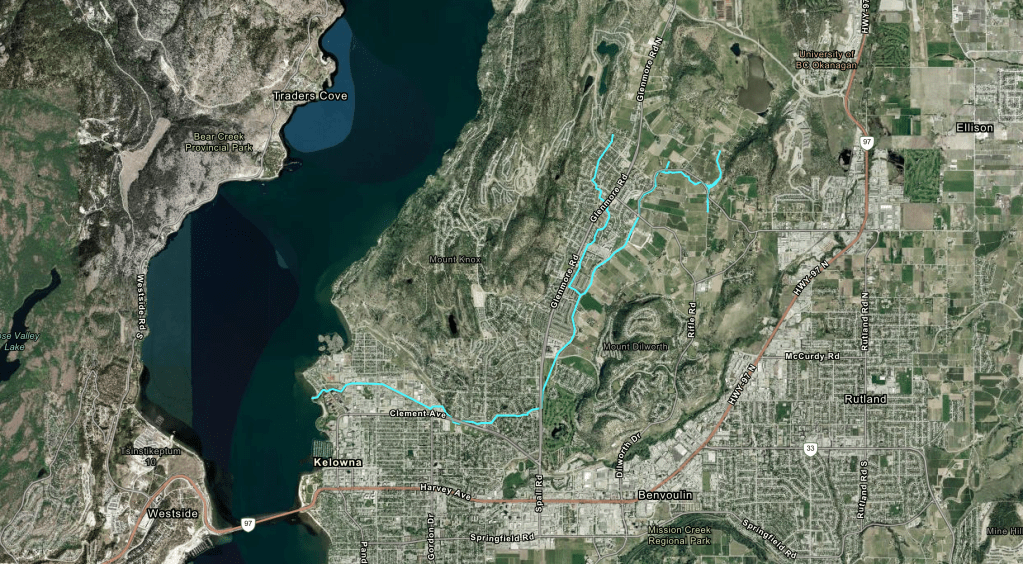
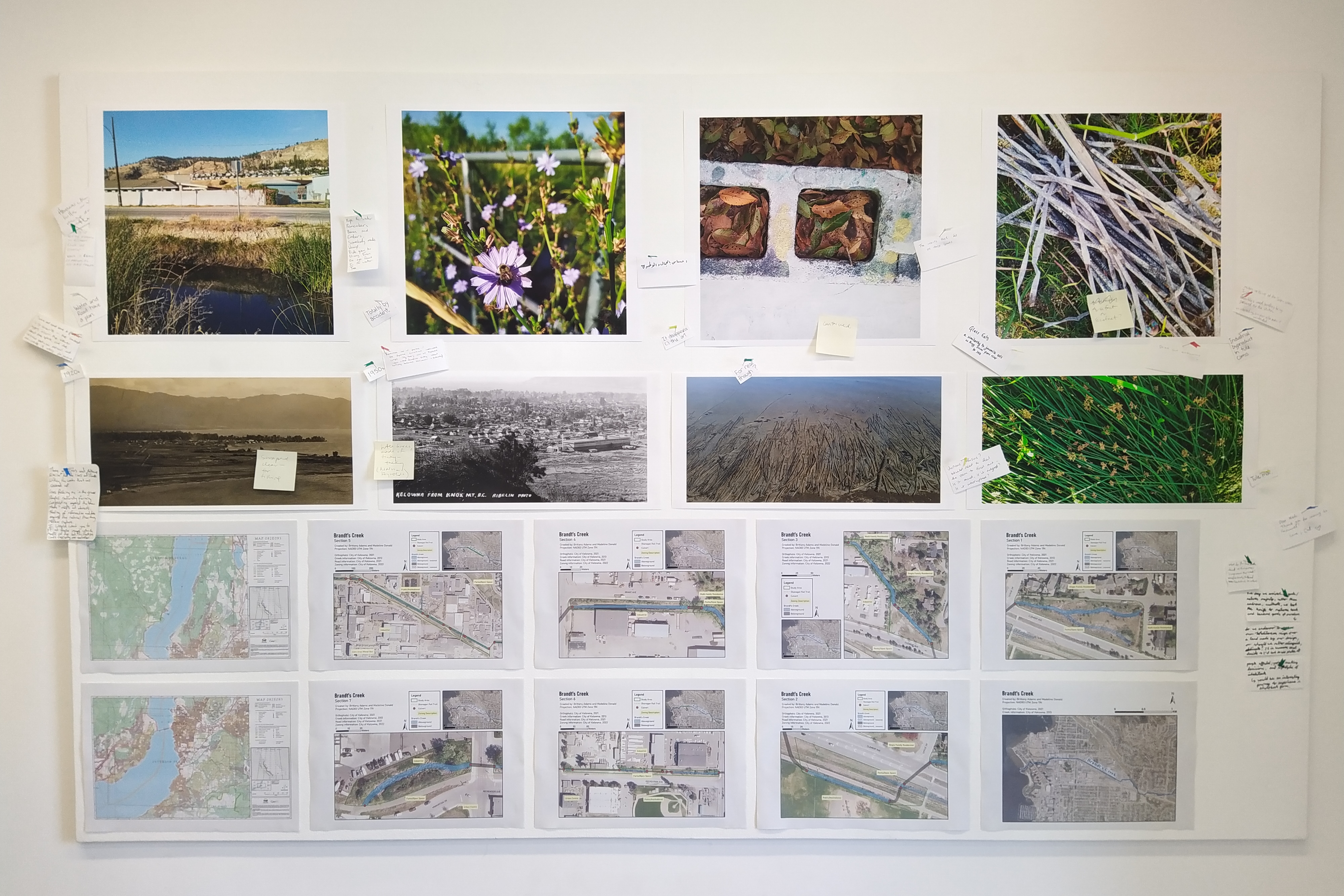
The riparian habitat with which I work most closely is that of Brandt’s Creek, in Kelowna, British Columbia, unceded and occupied syilx territory. This creek came into being as a result of Kelowna’s early colonial industrialization, a process that partitioned and paved over the expansive and ecologically complex floodplain that preceded the city, setting specific courses for water to flow through. Today, the waterways that run through Kelowna do not have the capacity to accommodate for current floodwaters, let alone the increasingly energetic and voluminous flows expected in our changing climate. I’m asking the question, ‘What does Brandt’s Creek need in order to be(come) its most bountiful and vibrant self given the past histories, current policy ecology, and future needs of its multi-being riparian communities?’
Creative Exchange at the University of Exeter’s Environment and Sustainability Institute
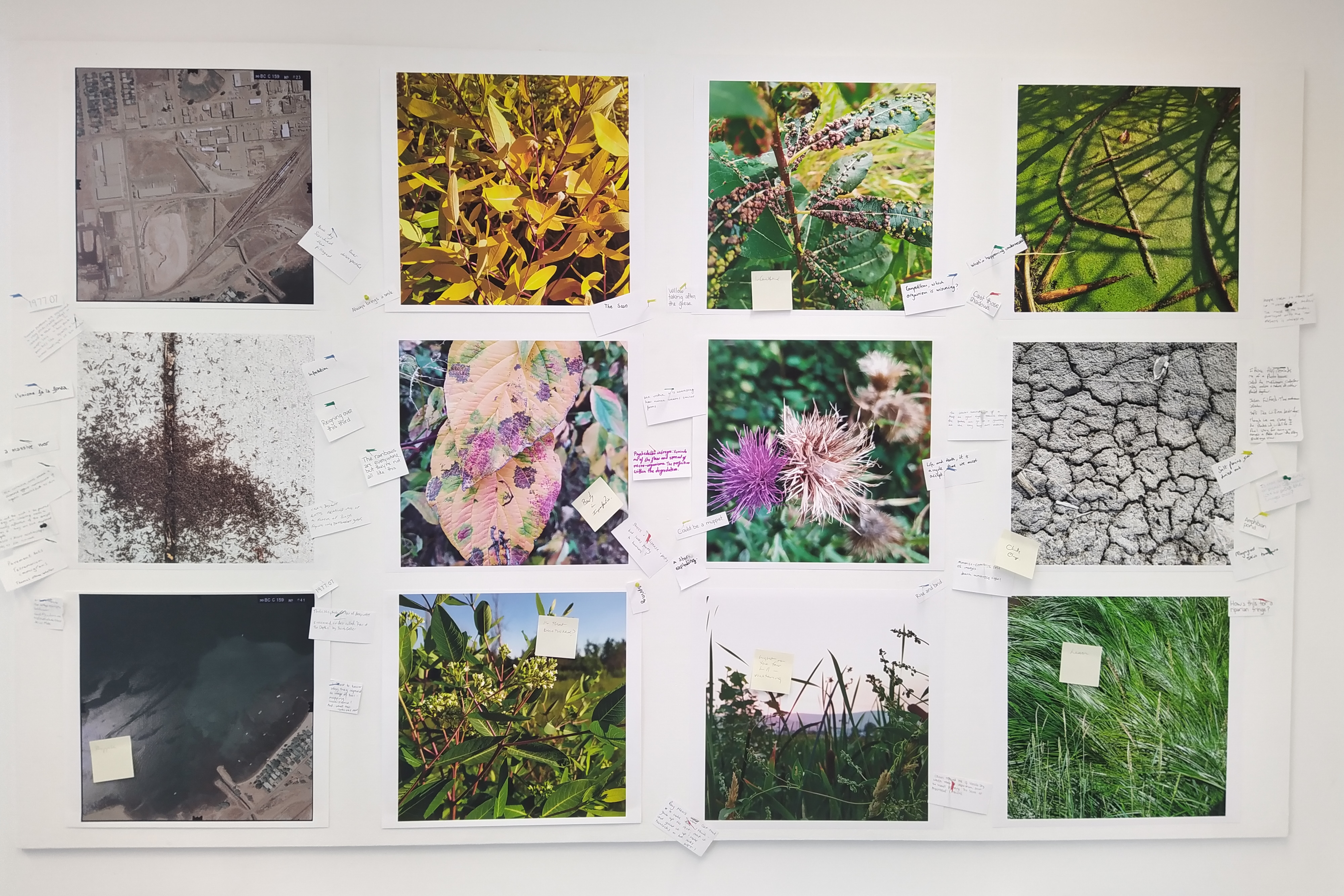
Embedded in this project is an inquiry into the processes of de-industrialization, or facilitated decay, that are necessary to actualize riparian re-habilitation in urban settings (e.g. the demolition of concrete and asphalt, re-homing of gravel, removal of invading plants, and negotiating with the lives and livelihoods of critters of all sorts). As Caitlin DeSilvey has written,
“[w]e need ways of valuing the material past that do not necessarily involve accumulation and preservation—ways that instead countenance the release of some of the things we care about into other systems of significance.”
Caitlin DeSilvey, 2017
The work of urban riparian rehabilitation is a dance between form and function, revitalization and acceptance of the climate to come, all embedded in a murky and unpredictable transition from late industrial capitalism—assumed to be nearing the end of its reign—to late industrial capitalism—as in “deceased.”
While visiting the Environment and Sustainability Institute (ESI) in January and February of 2023 I directed my focus toward the question of how riparian rehabilitation discourse and praxis can incorporate and honour the practices, processes, protocols, and material movements of facilitated decay?


writing

UBC Okanagan News
An article titled “A hidden waterway comes alive through community art,” was written by Viola Cohen and colleagues about the Riparian ReAnimation project as it relates to research with and alongside Brandt’s Creek in Kelowna, BC.
Creative Exchange Blog
I am simultaneously here and elsewhere to recount a small tale, the circumstances of which were made possible by fortuitous timing… [read more]
![[image description]](https://madelinedonald.net/wp-content/uploads/2023/04/img_20221011_102747.1-1.jpg?w=750)
This Is Not a Photograph: A Collection of Conversational Mini-Stories, Experimenting with Text and Texture
What follows is a two-part experiment in communication and redaction, corrugation and method. [read more]
 Madeline Donald